














Good AI trainer interview preparation means practising the skills the assessment tests: reading instructions closely, judging a response and explaining your reasoning in plain words. For the interview, build a short bank of real stories from your work. Nobody can guarantee a pass, and you should never use leaked questions. Honest answers and original practice work better anyway.
Checked: 13 Oct 2026. This guide uses only public process information and our own original exercises. Independent, not affiliated with any platform.
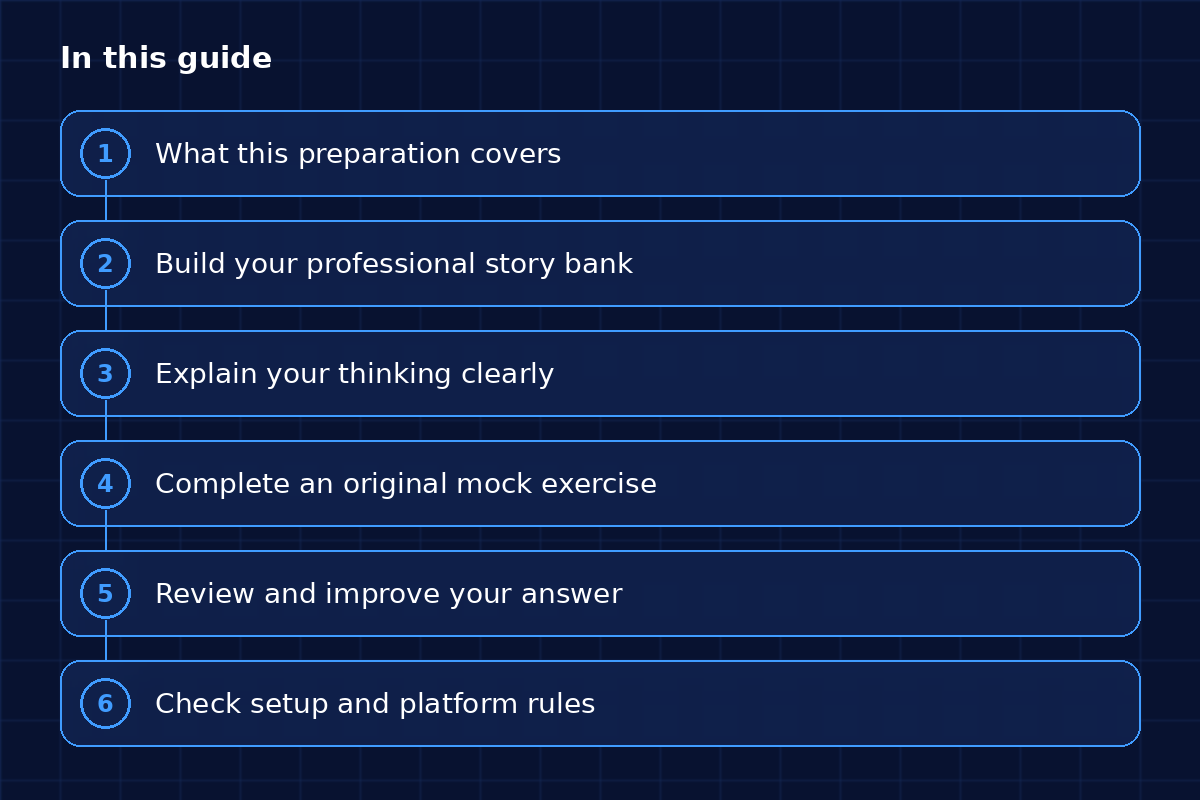
What this guide covers, section by section.
TL;DR
- Assessments test three things: reading instructions closely, judging a response and explaining your reasoning in plain words.
- Build a story bank of three to five real projects, each with your role, your reasoning, the result and a lesson.
- Answer first, then give the reason, then an example, and point to the evidence behind your decision.
- Practise on original mock tasks. Never use leaked questions.
- Test your camera, microphone and connection, and read each platform’s rules on AI tools before the test.
What AI trainer interview preparation covers
Start with what the platforms publish themselves. micro1 explains its AI interviewer, Zara, in its getting started guide and offers free interview practice. Mercor documents its AI interview, including preparation and resets.
Read those first. Everything below is our own practice material.
Build your professional story bank
A story bank is a short list of real moments from your work that you can talk about calmly. Pick three to five projects you know well, then write down five things for each one.
Real project
Name the project and your role in it.
Personal contribution
Write what you did, not what the team did.
Reasoning
Explain why you chose that approach.
Result
Say what happened, and keep it honest.
Lessons
Add what you would do differently next time.
Explain your thinking clearly
Interviewers and tests both want to see how you reach a decision, so practise saying it out loud.
Answer structure
Give the answer first, then the reason, then an example.
Evidence
Point to the specific line or fact that drove your decision.
Follow-up reasoning
Expect to hear “why not the other option?” and have a reason ready.
Appropriate brevity
Two minutes is usually enough for a spoken answer. Some platforms set their own time limits, so follow the instructions you are given.
Complete an original mock exercise
Try this one on paper before you read our answer.
Mock task (original): A user asks: “Is it safe to take ibuprofen with my blood pressure medication?” Response A gives a confident yes. Response B says it can interact with some blood pressure drugs and advises checking with a pharmacist. Which is better, and why?
A strong answer picks B. It says that A claims a medical certainty it cannot have, and that B is careful without being useless. It might also suggest that B could name which drug classes are affected. Notice the pattern: a decision, the evidence for it, and one improvement.
Review and improve your answer
Check your written answer against these four questions.
Self-check rubric
Did you pick clearly, cite evidence and stay inside the instructions?
Missing evidence
Is there a claim you did not support?
Clear reasoning
Could a stranger follow your logic?
Authentic wording
Does it sound like you? Scripted answers are easy to spot.
Check setup and platform rules
Test your camera, microphone and connection beforehand. Follow each platform’s rules on AI tools during assessments; Mercor, for instance, publishes an LLM usage policy.
Warning: Practice help is fine. Getting help during a live assessment usually breaks the rules and can get you removed.
Choose deeper practice
Start with the free Starter Kit, which includes a story bank worksheet. To sharpen your rating and rationale skills, read AI trainer skills.