






No Result
View All Result
Exclusive Updates
AI Trainers FAQ
  • Home
  • Start Here
  • FAQ
  • Platforms
    • All
    • Mercor FAQs
    • micro1 FAQs
    • Other Platform FAQs
    • Platform Comparisons
    • Platform Directory
    • Platform Reviews
    Illustration: two hands passing a blank card across a desk, for the micro1 referral program

    micro1 referral program: how talent referrals work

    A chessboard mid-game with one knight in focus, for practising fairly for the DataAnnotation Starter Assessment

    DataAnnotation Starter Assessment: how to practise fairly

    Three seedlings at different stages on a windowsill, for the DataAnnotation application wait time guide

    DataAnnotation application wait time: what to expect

    An empty checkout conveyor with one basket at the end, for what an Outlier empty queue means

    Outlier empty queue: what it means and what to check

    A teapot pouring into one of two teacups on a tray, for how Mercor referral program earnings sharing works

    Mercor referral program: how it works and what to check

    A bicycle leaning against a garden fence at dawn beside an empty path, for being accepted on Mercor with no job offer yet

    Accepted on Mercor with no job offer: what to check

    A quiet desk with a small cactus, a mug and a pencil, ready for a Mercor AI interview

    Mercor AI interview: how to prepare your examples

    Illustration: a resume in a leather portfolio with envelopes and a fountain pen beside a laptop, for the Mercor application process

    Mercor application process: how to present your experience

    Trending Tags

    • Mercor
    • Outlier
    • micro1
    • DataAnnotation
    • Mindrift
    • Alignerr
  • Applications
    • All
    • Application Roadmap
    • Profiles & Resumes
    Title card for the AI trainer application tracker listing its five columns

    AI trainer application tracker: log roles, tests and follow-ups

    Title card for the AI trainer application checklist with five ticked checks

    AI trainer application checklist: 15 checks before you apply

    Three spice jars on a shelf beside a wooden spoon, for how an AI trainer can choose a domain

    AI trainer: choose a domain for your AI interview

    A tailor's tape, chalk and scissors on a cutting table, for an AI trainer resume template built to fit

    AI trainer resume template: a simple format for beginners

    Illustration: a resume sheet in a leather folder with a fountain pen, glasses and ribboned papers, for a domain expert AI resume

    Domain expert resume: show your real work clearly

    Illustration: a staircase of blue books rising to an open laptop, framed by corner brackets, for a step-by-step guide to becoming an AI trainer

    How to become an AI trainer using your existing skills

    Trending Tags

    • Resume Writing
    • Project Matching
    • Beginners
    • Career Changers
    • Remote Work
    • Freelance
  • Interviews
    • All
    • Assessment Practice
    • Interview Preparation
    An empty stool under a spotlight on a stage, for writing a domain expert interview introduction

    Domain expert interview introduction: what to say

    An empty armchair beside a table with a glass and blank notebook, for AI trainer interview questions practice

    AI trainer interview questions with practice answers

    Illustration: an interview preparation desk with a studio microphone, a laptop with a webcam light, an open notebook and a glass of water

    AI trainer assessment and interview preparation guide

    Trending Tags

    • Interview Preparation
    • Mercor Interview
    • Zara Interview
    • Assessments
    • Interview Introduction
    • Practice Exercises
  • Skills
    • All
    • Core Skills
    • Evaluation & Feedback Writing
    Reading glasses on a stack of plain paper under a lamp, for AI evaluation rationale writing

    AI evaluation rationale writing: a five-step method

    Three pears lined up on a board for comparison, for how to rank AI responses with a rubric

    How to rank AI responses with a rubric

    Illustration: a magnifying glass, a pencil, checklist cards and blue tabs on a navy desk, for core AI trainer rating and rubric skills

    AI trainer skills: prompts, rubrics, ratings, feedback

    Trending Tags

    • Rubric Writing
    • Rationale Writing
    • Prompt Writing
    • Response Ranking
    • Tool-Use Evaluation
    • Worked Examples
  • Exclusive
No Result
View All Result
AI Trainers FAQ

AI trainer skills: prompts, rubrics, ratings, feedback

Home AI Training Skills
Share on WhatsappShare on LinkedInShare on RedditShare on GPT

Of all the AI trainer skills, evaluation is the core one. You decide whether an AI response does what was asked, is correct and is useful, and then you explain that decision in clear words. Prompt writing, rubric writing and rating all build on it, and you can practise every one with a chatbot, a notebook and a checklist.

Checked: 13 Oct 2026. The examples are original. Independent, not affiliated with any platform.
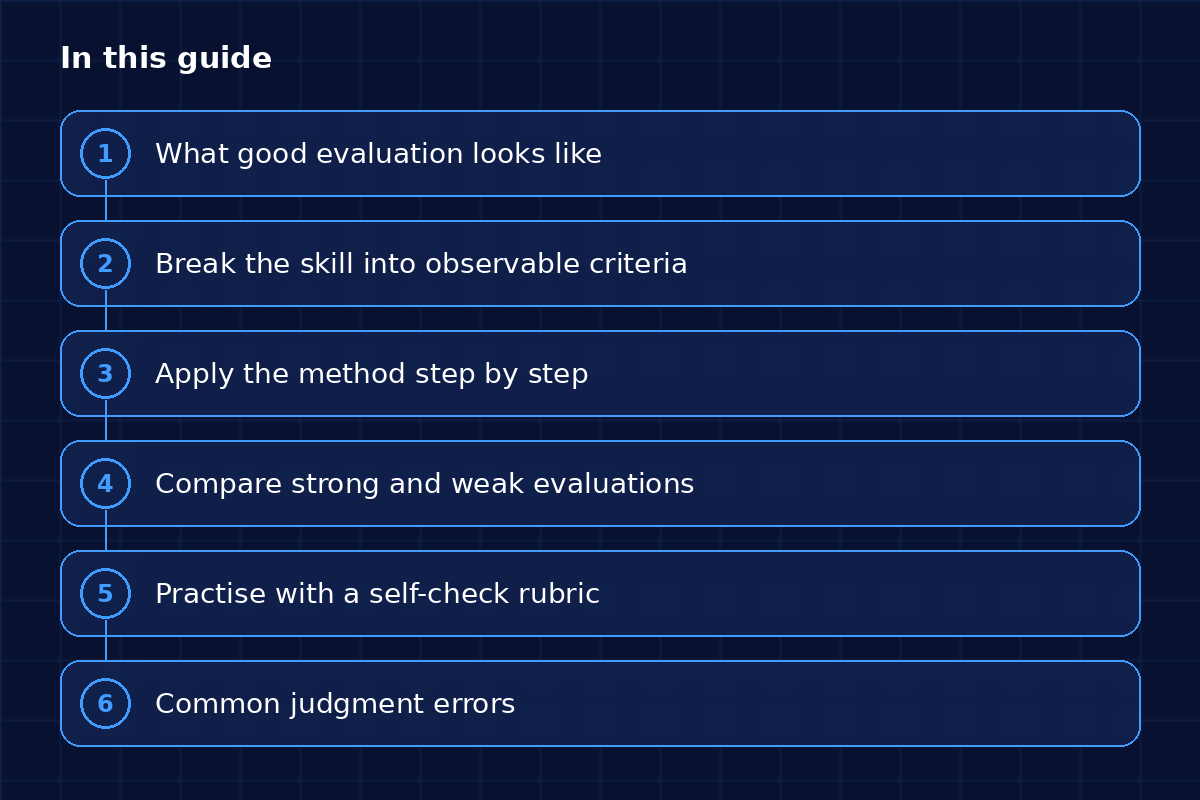
Step diagram of the sections in this guide: What good evaluation looks like; Break the skill into observable criteria; Apply the method step by step; Compare strong and weak evaluations; Practise with a self-check rubric; Common judgment errors

What this guide covers, section by section.
Navy and electric blue glass panel with the title AI trainer skills: prompts, rubrics, ratings and clear feedback

TL;DR

  • Evaluation is the core skill: you judge whether a response does what was asked, is correct and is useful.
  • Four questions cover most tasks: instruction adherence, correctness, evidence and usefulness.
  • Use the same six steps on every task, from reading the instructions twice to writing the rationale.
  • Specific rationales name the constraint or the error, which is why reviewers score them higher.
  • Missed constraints are the most common mistake, so reread the instructions before you submit.
  • You can practise with a chatbot, a notebook and a self-check rubric.

What good evaluation looks like

Take a look at this small example.

Example (fictional): Prompt: “Summarise this paragraph in one sentence for a 10-year-old.” The response is accurate but runs to three sentences and uses the word “macroeconomic.” A good rating marks it down for both instruction misses, even though the facts are right.

Good evaluation is specific, consistent and tied to the instructions.

Break AI trainer skills into observable criteria

Four questions cover most tasks.

Instruction adherence

Did the response do what was asked? Check length, format, audience and constraints.

Correctness

Are the facts, calculations and logic right?

Evidence

Are the claims supported, or invented? Hallucinated citations count as errors.

Usefulness

Would the real user be helped? A technically correct answer can still miss the point.

Apply the method step by step

Use the same six steps on every task:

  1. Read the instructions twice and note every constraint.
  2. Read the response once without judging it.
  3. Check each constraint and mark pass or fail.
  4. Check the facts you can verify.
  5. Decide your rating.
  6. Write the rationale: your verdict, your top reason, then your second reason.

Compare strong and weak evaluations

Specific rationales are easy for a reviewer to check, which is why they score higher.

Weak rationaleStrong rationale
“Response A is better.”“A follows the 100-word limit; B runs to 180.”
“B has some errors.”“B says the Eiffel Tower opened in 1899; it opened in 1889.”
“Good tone.”“A uses plain words suited to the stated beginner audience.”

Original examples.

Practise with a self-check rubric

Pick any question and ask a chatbot for two answers. Rate them, then score your own rationale with three questions: does it name a specific constraint, cite a specific error and give a clear verdict? Three yeses make a solid rationale.

Common judgment errors

Reviewers flag the same four mistakes again and again.

Unsupported preference

“I like A more” is not a reason a reviewer can check.

Vague feedback

Name the line, the fact or the constraint.

Double counting

Do not punish one mistake under three different criteria.

Missed constraints

This is the most common miss. Reread the instructions before you submit.

Use the skill in a real workflow

Real projects add guidelines, reviewers and quality scores. micro1 describes peer, operations and client review layers in its quality guide. Read what AI trainers do to see how tasks fit together, and grab the practice sheets in the free Starter Kit.

FAQs

What is the most important AI trainer skill?

Evaluation. You decide whether an AI response follows the instructions, is correct and is useful, then you explain that decision in clear words. Prompt writing, rubric writing and rating all build on this one skill.

Can I practise AI trainer skills at home?

Yes. Ask a chatbot for two answers to the same question, rate them and write a short rationale. Then check it: does it name a specific constraint, cite a specific error and give a clear verdict? Three yeses make a solid rationale.

What makes a rationale strong?

A strong rationale is specific enough for a reviewer to check. Give your verdict, your top reason and your second reason. Name the line, the fact or the constraint, for example a word limit the response ignored or a wrong date.

What mistakes do reviewers flag most?

Missed constraints come up most often. Reviewers also flag unsupported preferences like “I like A more”, vague feedback and double counting, where one mistake is punished under several criteria. Rereading the instructions before you submit prevents most of them.
Tags: BeginnersPrompt WritingRubric Writing
Previous Post

AI training jobs: the complete beginner guide

Next Post

What AI trainers do: a guide to tasks and workflows

Related Posts

Illustration: two hands passing a blank card across a desk, for the micro1 referral program
AI Training Platforms

micro1 referral program: how talent referrals work

by AI Trainers FAQ
0
2

How the micro1 referral program works under its official terms: who can take part, consent, when a referral counts, banned...

Read moreDetails
Title card for the AI trainer application tracker listing its five columns

AI trainer application tracker: log roles, tests and follow-ups

1
Title card for the AI trainer application checklist with five ticked checks

AI trainer application checklist: 15 checks before you apply

2
A chest camera strap beside a folded apron on a kitchen chair, for robotics data collection jobs

Robotics data collection jobs: recording everyday tasks

1
Load More
Next Post
Illustration: a reviewer seen from behind, holding a pen at a laptop that shows two answer panels with a tick on one, for what an AI trainer does

What AI trainers do: a guide to tasks and workflows

Table of Contents

  • TL;DR
  • What good evaluation looks like
  • Break AI trainer skills into observable criteria
  • Apply the method step by step
  • Compare strong and weak evaluations
  • Practise with a self-check rubric
  • Common judgment errors
  • Use the skill in a real workflow
  • FAQs
Free downloadAI Trainer Starter KitThe AI Trainer Starter Kit on laptop, phone, Excel and PDF30-day plan, eligibility log, application tracker, story bank, rating practice and pay calculator.Get the free kit

Browse topics

  • AI training platforms31
  • Assessments and interviews15
  • Applications14
  • Eligibility and requirements13
  • AI training skills12
  • Task types5
  • Domain experts5
Got a question?

Ask anonymously. No email needed. We answer and link you to the right guide.

Ask a question
?AI Trainers FAQ

AI training work is new and honestly a bit confusing. We are exploring it too, and we share what we learn here: what platforms ask for, what the tests look like, and what we wish we had known sooner.

No hype and no income promises. Partner links are always marked.

Start here

New to this?

  • AI training jobs explained
  • How to become an AI trainer
  • Your first 30 days
  • Tests and interviews
  • Spotting scams

Platforms

  • Compare platforms
  • Mercor
  • micro1
  • Outlier
  • DataAnnotation

Got a question?

Ask us anonymously

No email needed. We answer in public, so everyone learns from it.

Ask a question

Free: AI Trainer Starter Kit

  • About Us
  • Disclaimer
  • Privacy Policy
  • Terms and Conditions
  • Contact Us

© 2026 AI Trainers FAQ. Independent guides for AI trainers. Partner links are always marked.

No Result
View All Result
  • Home
  • Start Here
  • FAQ
  • Platforms
  • Applications
  • Interviews
  • Skills
  • Exclusive

© 2026 AI Trainers FAQ. Independent guides for AI trainers. Partner links are always marked.

This website uses cookies. By continuing to use this website you are giving consent to cookies being used. Visit our Privacy and Cookie Policy.