






No Result
View All Result
Exclusive Updates
AI Trainers FAQ
  • Home
  • Start Here
  • FAQ
  • Platforms
    • All
    • Mercor FAQs
    • micro1 FAQs
    • Other Platform FAQs
    • Platform Comparisons
    • Platform Directory
    • Platform Reviews
    Illustration: two hands passing a blank card across a desk, for the micro1 referral program

    micro1 referral program: how talent referrals work

    A chessboard mid-game with one knight in focus, for practising fairly for the DataAnnotation Starter Assessment

    DataAnnotation Starter Assessment: how to practise fairly

    Three seedlings at different stages on a windowsill, for the DataAnnotation application wait time guide

    DataAnnotation application wait time: what to expect

    An empty checkout conveyor with one basket at the end, for what an Outlier empty queue means

    Outlier empty queue: what it means and what to check

    A teapot pouring into one of two teacups on a tray, for how Mercor referral program earnings sharing works

    Mercor referral program: how it works and what to check

    A bicycle leaning against a garden fence at dawn beside an empty path, for being accepted on Mercor with no job offer yet

    Accepted on Mercor with no job offer: what to check

    A quiet desk with a small cactus, a mug and a pencil, ready for a Mercor AI interview

    Mercor AI interview: how to prepare your examples

    Illustration: a resume in a leather portfolio with envelopes and a fountain pen beside a laptop, for the Mercor application process

    Mercor application process: how to present your experience

    Trending Tags

    • Mercor
    • Outlier
    • micro1
    • DataAnnotation
    • Mindrift
    • Alignerr
  • Applications
    • All
    • Application Roadmap
    • Profiles & Resumes
    Title card for the AI trainer application tracker listing its five columns

    AI trainer application tracker: log roles, tests and follow-ups

    Title card for the AI trainer application checklist with five ticked checks

    AI trainer application checklist: 15 checks before you apply

    Three spice jars on a shelf beside a wooden spoon, for how an AI trainer can choose a domain

    AI trainer: choose a domain for your AI interview

    A tailor's tape, chalk and scissors on a cutting table, for an AI trainer resume template built to fit

    AI trainer resume template: a simple format for beginners

    Illustration: a resume sheet in a leather folder with a fountain pen, glasses and ribboned papers, for a domain expert AI resume

    Domain expert resume: show your real work clearly

    Illustration: a staircase of blue books rising to an open laptop, framed by corner brackets, for a step-by-step guide to becoming an AI trainer

    How to become an AI trainer using your existing skills

    Trending Tags

    • Resume Writing
    • Project Matching
    • Beginners
    • Career Changers
    • Remote Work
    • Freelance
  • Interviews
    • All
    • Assessment Practice
    • Interview Preparation
    An empty stool under a spotlight on a stage, for writing a domain expert interview introduction

    Domain expert interview introduction: what to say

    An empty armchair beside a table with a glass and blank notebook, for AI trainer interview questions practice

    AI trainer interview questions with practice answers

    Illustration: an interview preparation desk with a studio microphone, a laptop with a webcam light, an open notebook and a glass of water

    AI trainer assessment and interview preparation guide

    Trending Tags

    • Interview Preparation
    • Mercor Interview
    • Zara Interview
    • Assessments
    • Interview Introduction
    • Practice Exercises
  • Skills
    • All
    • Core Skills
    • Evaluation & Feedback Writing
    Reading glasses on a stack of plain paper under a lamp, for AI evaluation rationale writing

    AI evaluation rationale writing: a five-step method

    Three pears lined up on a board for comparison, for how to rank AI responses with a rubric

    How to rank AI responses with a rubric

    Illustration: a magnifying glass, a pencil, checklist cards and blue tabs on a navy desk, for core AI trainer rating and rubric skills

    AI trainer skills: prompts, rubrics, ratings, feedback

    Trending Tags

    • Rubric Writing
    • Rationale Writing
    • Prompt Writing
    • Response Ranking
    • Tool-Use Evaluation
    • Worked Examples
  • Exclusive
No Result
View All Result
AI Trainers FAQ

AI training jobs: the complete beginner guide

Home Getting Started Beginner Roadmap
Share on WhatsappShare on LinkedInShare on RedditShare on GPT

You have probably seen the ads that say “Get paid to train AI.” Many of them point to real platforms. What they leave out is how much of the work is waiting, testing and checking rules. This guide covers what the work is, who it suits and how to start without wasting months.

This post contains affiliate links. We may receive compensation if you join through this link.

AI training jobs are contract tasks where you read, rate, write or correct the text, images or audio that AI models learn from. Most roles want clear writing and careful reading, and many expert roles also expect professional experience in a field like law, healthcare or finance.

You do not need to be a programmer or have a technology degree. You do need patience, careful judgment and a realistic idea of how much work to expect.

Checked: 13 Oct 2026. AI Trainers FAQ is independent. Platform rules change often, so check the platform’s own pages before you apply.

TL;DR

  • AI training work means checking, rating and improving the answers that AI models produce.
  • Most general tasks need good written English, careful reading and a clear explanation for every decision.
  • Expert roles usually ask for professional experience or a recognised qualification in your field.
  • A platform can approve your application and still have no work for you for several weeks.
  • Legitimate platforms never ask you to pay a registration fee.
  • A five-step plan covers your angle, a platform shortlist, your resume, careful applications and regular practice.

In this guide

  • What are AI training jobs?
  • What does the work involve day to day?
  • Who is AI training work good for?
  • Do you qualify? Five things to check
  • The beginner roadmap: five steps
  • What to expect about work and pay
  • How to stay safe
  • Common beginner mistakes
  • Your next step into AI training work
  • Sources
Is AI training work real? The honest beginner roadmap. Blue duotone laptop with annotation boxes around the screen and keyboard

What are AI training jobs?

An AI model learns from huge sets of examples, and people make many of those examples by hand. People also review the model’s answers, explain what is right or misleading and suggest better versions. The industry calls all of that human feedback AI training work.

Companies use many titles for it, including “AI trainer,” “AI tutor,” “rater,” “annotator,” “evaluator” and “expert contributor”. Whatever the title, you look at what the AI produced, compare it with the project guidelines and give your honest judgment.

Most of this work is remote contract work with no salary. You usually sign up with a platform, pass some tests and then wait to be matched with projects.

Two blue artwork cards side by side with a pencil and a checklist card, each card framed by annotation corners, like comparing two answers

A typical task: compare two answers against a checklist, then rate and explain. Generated illustration.

Which companies hire AI trainers?

AI companies need a huge amount of human feedback, and many of them use outside platforms to find, test and manage the people who give it. Some platforms specialise in professionals such as doctors, lawyers or engineers. Others focus on general writing and rating work, and a few focus on language and audio tasks.

You will see names like micro1, Mercor, Outlier, DataAnnotation, Mindrift, Alignerr, CrowdGen by Appen, TELUS Digital, OneForma and Prolific. Each one works a little differently, and our platform comparison explains the differences in plain words.

What does the work involve day to day?

Most tasks follow one pattern. You get an input, read the project rules, make a decision and write a short reason for it.

Common task categories

Here are the seven kinds of task you will meet most often:

  • Rating answers: you compare two AI answers and choose the better one.
  • Writing reasons: you explain your rating in two to four sentences.
  • Writing prompts: you write questions that test what the AI can and cannot do.
  • Fixing answers: you rewrite a wrong or weak answer so it is correct.
  • Fact-checking: you verify claims against reliable sources.
  • Labelling: you sort text, images, audio or video into categories.
  • Expert review: you check answers in your own field, like tax, medicine or law.

Some newer projects ask people to record real tasks, like household jobs, to help robots learn. Our guide to what AI trainers do covers each type in more detail.

A small example

Here is a made-up task, so you can see how it feels.

The task

Example (fictional): The user asks: “Give me three quick dinner ideas with no dairy.” Answer A gives three meals, but one has cheese on top. Answer B gives three dairy-free meals, but one takes 45 minutes. Which is better?

How a strong trainer decides

Three moves get you to the answer.

Finding both problems

Both answers break a rule, and a careful trainer notices both before deciding anything.

Deciding which problem matters more

Next, ask which problem matters more to this particular user. Dairy might be a medical allergy, which would make Answer A’s mistake more serious than a slow recipe.

Writing a specific reason

You might pick B and write: “B follows the no-dairy rule. A includes cheese, which breaks the main request. B’s second meal is slow, but that is a smaller issue.”

The hard part of that task was the reading. You had to spot two problems, rank them for this user and explain your choice in plain words. Platforms test for exactly that.

What reviewers look for

Experienced reviewers often check your work. They look at whether you followed the project rules, whether your rating makes sense and whether your reason is clear and specific. A vague reason like “B is better” usually scores low, while a specific one like “A uses cheese, which the user said not to” scores higher.

Who is AI training work good for?

Some people enjoy this work and others find it frustrating, so be honest with yourself before you spend hours on applications.

Signs it may suit you

  • You enjoy reading carefully and noticing small mistakes in detailed material.
  • You can write short, clear explanations for your decisions.
  • You are comfortable following long, detailed instructions exactly.
  • You want flexible, remote work and can manage irregular hours.
  • You have specialist knowledge in a subject or profession.
  • You speak more than one language at a professional level.

Signs it may not suit you

  • You need a steady, predictable monthly income immediately.
  • You dislike reading long, detailed instructions.
  • You prefer to finish tasks quickly rather than accurately.
  • You expect guaranteed work right after registration.

If you are unsure, that is fine. Read our guide on starting with no AI experience to see what platforms look for instead.

Do you qualify? Five things to check

Check these five things before you apply anywhere. They decide most applications before anyone reads your resume.

Five glass checklist cards for experience, language, location, equipment and role needs

Check these five things before you apply.

1. Experience

General tasks often accept people with no AI background. Expert roles usually require a degree, a professional licence or several years in the field, and a short online course does not replace those.

2. Language

Most English-language roles require strong written English, and some platforms test it during the application. If you are bilingual, you may have extra options. Our multilingual guide explains how language roles work.

3. Where you live

Residence, not nationality

Most platforms care about the country you live in, and your passport matters less. Each project can also have its own list of countries, and our country eligibility guide shows you how to check.

4. Equipment

You need a reliable computer and a stable internet connection, and some assessments also use a webcam and microphone. A phone alone is rarely enough.

5. Role-specific skills

Coding roles need real coding skills, but most writing and rating work needs no code at all. See do you need coding skills for a clear breakdown.

CheckWhat to look forWhere to find it
ExperienceDegree, licence or years in a field (expert roles)Job listing requirements
LanguageRequired level of English or another languageListing and platform language tests
LocationYour country on the allowed listListing location field, platform FAQ
EquipmentComputer, reliable internet connection, webcamPlatform technical requirements page
SkillsCoding or subject skills named in the listingListing requirements

Every platform and project sets its own rules. Always check the listing.

The beginner roadmap: five steps

You do not need to do everything at once. Taking these five steps in order keeps things simple and helps you avoid early mistakes.
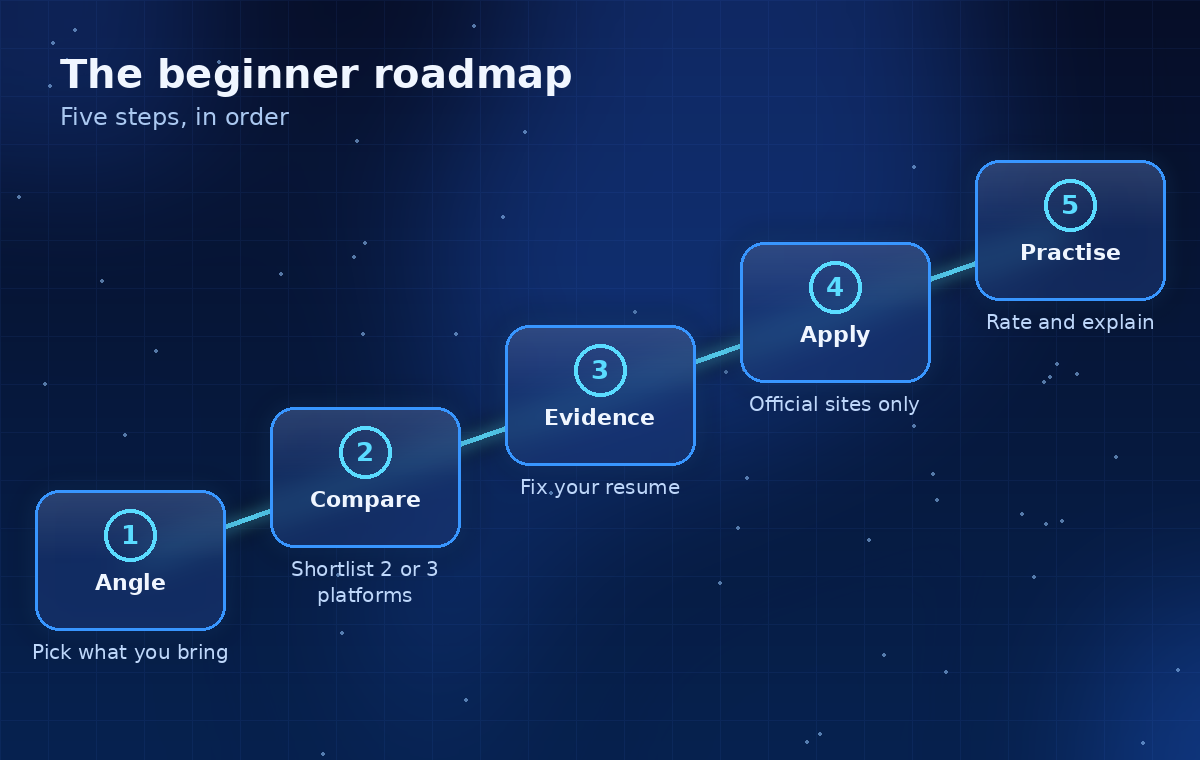
Glowing glass path with five numbered steps from choosing an angle to practising

The five-step beginner roadmap.

Step 1: Choose your angle

Think about the experience you actually bring. It might be strong writing, ten years as a nurse or fluent Spanish. Pick one main angle and lead with it, because it decides which platforms, projects and resume examples make sense for you.

Step 2: Compare platforms

Platforms differ in their task types, their assessments and the countries they accept. Shortlist two or three that fit your angle and your location, and use our platform comparison as a starting point.

Step 3: Prepare your evidence

Update your resume so it shows real tasks you completed and what changed because of them. Skip vague descriptions like “passionate” or “detail-oriented.” Our domain expert resume guide shows a before-and-after example.

Step 4: Apply carefully

Apply on each platform’s official website and complete every field honestly. Many platforms also use qualification tests or an AI interview, and the interview preparation guide helps you get ready without any shortcuts.

Step 5: Practise while you wait

Waiting is normal, so use the time. Ask a chatbot a question, get two different answers, compare them against a simple checklist and write a short reason. A few rounds a week build the habits that rating projects test, and our AI trainer skills guide gives you a simple method.

If you want a ready-made plan, try our first 30 days plan. It turns these steps into weekly goals.

What to expect about work and pay

Many ads skip this part, so read it slowly.

Three numbers people mix up

When people read about this work, they often confuse three different numbers.

  • The posted rate is what a project pays per hour or per task.
  • Task access is whether there is actually work in your queue.
  • Monthly income is what you really earn, after unpaid time and fees.

A high posted rate means little if you only get a few hours of work each month. Some activities, such as reading guidelines, doing training or installing software, may not be paid at all.
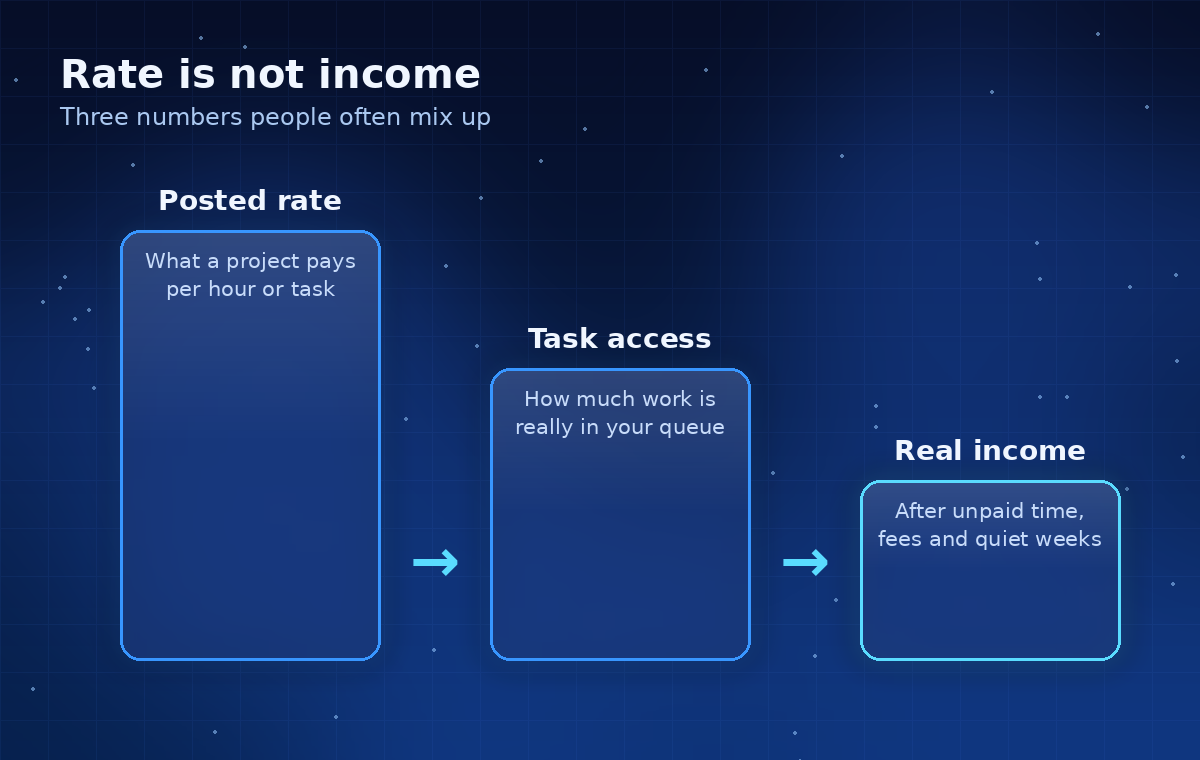
Three glass bars labelled posted rate, task access and real income getting smaller left to right

Posted rate, task access and real income are three different things.

Irregular availability

A platform might accept you and still show you an empty dashboard for several weeks, which happens to many contributors. Projects start, pause and end with client demand, so some weeks are busy and others are quiet. Plan for it as flexible contract work with no fixed income.

If your queue is empty, read our guide on what to do when there are no tasks. For how rates, paid time and fees work, see the AI trainer pay guide.

Warning: We do not share “typical earnings” because we have not verified them, and they vary a lot by project, country and skill. Be careful with anyone who promises a fixed income.

How to stay safe

Scammers know that many people want remote work, so they often pretend to be real platforms. These are the warning signs we see most.

Blue duotone photo of a smartphone in a solid annotation box beside an envelope in a dashed warning box

Check where a message came from before you trust it. Generated illustration.

  • Someone asks you to pay a registration or training fee before you start.
  • A “recruiter” contacts you first on WhatsApp, Telegram or a personal email address.
  • The advertised pay sounds unusually high for very simple work.
  • Someone pressures you to decide immediately.
  • Someone asks you to transfer or receive money on their behalf.

Start from the platform’s official website by typing the address yourself, and never send identity documents to someone who contacted you first. Our legitimacy checklist covers this in full.

Common beginner mistakes

Most beginner problems come from the same five mistakes.

Applying everywhere at once

Ten rushed applications usually perform worse than three careful ones, so focus on platforms that match your experience.

Claiming skills you don’t have

Qualification tests often check your claims. An honest beginner profile holds up, while an exaggerated one usually falls apart in the first assessment.

Ignoring project guidelines

Guidelines can be long and detailed. Read them completely anyway, because most early quality problems come from skipped instructions.

Using AI tools when not allowed

Some projects ban outside AI tools completely, and others allow limited use. Follow the rules of the project you are on.

Expecting immediate results

Replies, approvals and first tasks can take weeks, so plan for a slow start.

Your next step into AI training work

AI training work is real, and it can suit careful readers, clear writers and people with deep subject knowledge. It is also contract work. Platforms test you, projects come and go, and nobody can promise you steady hours.

If you have professional experience and want to look at live expert roles, you can browse micro1 roles Referral link or Mercor Referral link once you have checked your eligibility.

Open our first 30 days plan today and finish day one.

Free download: Get the AI Trainer Starter Kit: a 30-day plan, application checklist and tracker, interview story bank and rating practice with worked answers, as a PDF and an Excel workbook.

Sources

  • Outlier FAQ (checked 12 Oct 2026)
  • DataAnnotation FAQ (checked 12 Oct 2026)
  • micro1 expert library: getting started, types of work and quality review (checked 12 Oct 2026)
  • Mercor talent documentation: AI interview and LLM usage policy (checked 12 Oct 2026)
  • Mercor resources (checked 12 Oct 2026)
  • Mindrift: become an AI trainer with no experience (checked 12 Oct 2026)
Are AI training jobs real?

Yes. Many are run by established companies that publish their contractor terms. Scammers use the same language, though, and legitimate platforms never charge a registration fee.

Can I do this with no experience?

Often, yes, for general tasks, which mainly need careful reading and clear writing. Expert roles are different and usually require professional experience in the field.

Do I need to know how to code?

No, not for most tasks. Rating answers, writing prompts and checking facts need careful reading and clear writing. Only programming roles require code, and those listings say so clearly. See do you need coding skills.

Can I work part time?

Usually, yes, because most roles are contract work and you choose when to log in. Some projects set a minimum number of hours each week or a deadline, so check the listing. See part-time AI training work.

How long until my first task?

It depends on the platform, the open projects and your profile. The platforms we checked do not publish an average wait, so we do not give one.

Is the pay good?

Rates vary by project, skill and country, and your actual income depends on how much work you receive. Read the pay guide before you plan around it.

Tags: Beginners
Previous Post

How to become an AI trainer using your existing skills

Next Post

AI trainer skills: prompts, rubrics, ratings, feedback

Related Posts

Illustration: two hands passing a blank card across a desk, for the micro1 referral program
AI Training Platforms

micro1 referral program: how talent referrals work

by AI Trainers FAQ
0
2

How the micro1 referral program works under its official terms: who can take part, consent, when a referral counts, banned...

Read moreDetails
Title card for the AI trainer application tracker listing its five columns

AI trainer application tracker: log roles, tests and follow-ups

1
Title card for the AI trainer application checklist with five ticked checks

AI trainer application checklist: 15 checks before you apply

2
A chest camera strap beside a folded apron on a kitchen chair, for robotics data collection jobs

Robotics data collection jobs: recording everyday tasks

1
Load More
Next Post
Illustration: a magnifying glass, a pencil, checklist cards and blue tabs on a navy desk, for core AI trainer rating and rubric skills

AI trainer skills: prompts, rubrics, ratings, feedback

Table of Contents

  • TL;DR
  • What are AI training jobs?
  • What does the work involve day to day?
  • Who is AI training work good for?
  • Do you qualify? Five things to check
  • The beginner roadmap: five steps
  • What to expect about work and pay
  • How to stay safe
  • Common beginner mistakes
  • Your next step into AI training work
  • Sources
Free downloadAI Trainer Starter KitThe AI Trainer Starter Kit on laptop, phone, Excel and PDF30-day plan, eligibility log, application tracker, story bank, rating practice and pay calculator.Get the free kit

Browse topics

  • AI training platforms31
  • Assessments and interviews15
  • Applications14
  • Eligibility and requirements13
  • AI training skills12
  • Task types5
  • Domain experts5
Got a question?

Ask anonymously. No email needed. We answer and link you to the right guide.

Ask a question
?AI Trainers FAQ

AI training work is new and honestly a bit confusing. We are exploring it too, and we share what we learn here: what platforms ask for, what the tests look like, and what we wish we had known sooner.

No hype and no income promises. Partner links are always marked.

Start here

New to this?

  • AI training jobs explained
  • How to become an AI trainer
  • Your first 30 days
  • Tests and interviews
  • Spotting scams

Platforms

  • Compare platforms
  • Mercor
  • micro1
  • Outlier
  • DataAnnotation

Got a question?

Ask us anonymously

No email needed. We answer in public, so everyone learns from it.

Ask a question

Free: AI Trainer Starter Kit

  • About Us
  • Disclaimer
  • Privacy Policy
  • Terms and Conditions
  • Contact Us

© 2026 AI Trainers FAQ. Independent guides for AI trainers. Partner links are always marked.

No Result
View All Result
  • Home
  • Start Here
  • FAQ
  • Platforms
  • Applications
  • Interviews
  • Skills
  • Exclusive

© 2026 AI Trainers FAQ. Independent guides for AI trainers. Partner links are always marked.

This website uses cookies. By continuing to use this website you are giving consent to cookies being used. Visit our Privacy and Cookie Policy.