














An AI trainer salary is rarely a salary. Most AI trainers are paid as contractors, not as salaried employees. Platforms pay hourly or per task, only for approved or billable work, and availability varies. So the posted rate is not your income. What you earn depends on how much work you get, how much of your time counts as billable, and any fees or taxes.
We do not publish typical earnings, because we have not verified them and they vary too much. Here is how to read the numbers you do see.
Checked: 13 Oct 2026. This is not financial or tax advice. Independent, not affiliated with any platform.
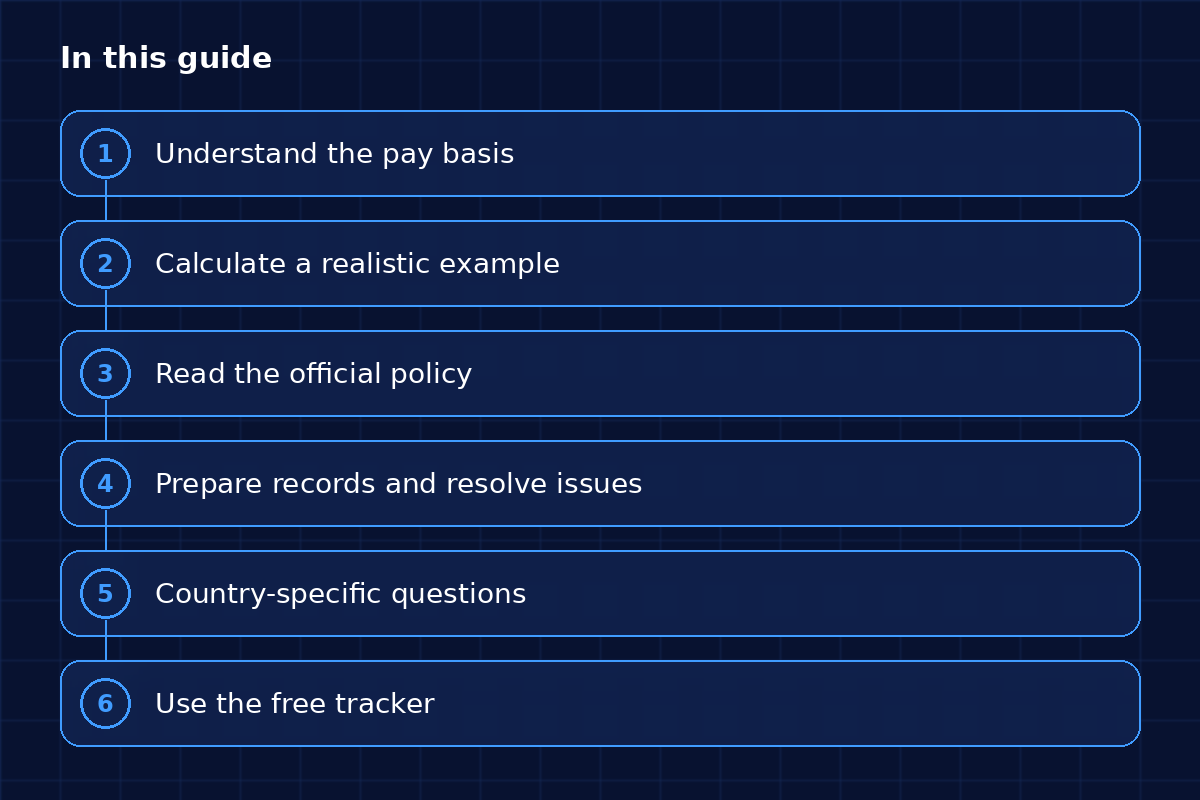
What this guide covers, section by section.
TL;DR
- Most AI trainers are paid as contractors, hourly or per task, and not as salaried employees.
- Platforms pay only for approved or billable work, and availability varies.
- The posted rate is not your income: unpaid time, fees and taxes all change your real rate.
- Read your contractor agreement and the platform’s documentation for pay terms.
- Keep your own log of approved tasks, tracked time and pay-period cutoffs.
- We do not publish typical earnings, because we have not verified them.
Understand the AI trainer salary basis
Four things shape what lands in your account.
Hourly or task-based
Hourly roles pay for tracked time. Task roles pay per approved item, so your speed and approval rate matter.
Approval rules
Rejected work may not be paid, so read each project’s rules.
Payout timing
Platforms publish their schedules, and micro1 has a payroll policy. Recheck the dates for your country.
Fees
Payment providers may charge transfer or currency fees.
Calculate a realistic example
Here is the maths for one week.
Example (fictional numbers, not typical income): Posted rate: 20 per hour. In one week you log 10 billable hours, and you also spend 3 unpaid hours on onboarding and reading guidelines. A 2% payout fee applies. Pay: 200 minus 4 fee = 196. Your real rate across 13 hours is about 15.08 per hour, before tax.
| Input | Your number |
|---|---|
| Posted rate | |
| Billable hours | |
| Unpaid hours (setup, reading, waiting) | |
| Fees (%) | |
| Real rate = (rate × billable × (1 − fee)) ÷ total hours |
Swap in your own numbers. Tax is not included.
Read the official policy
Pay terms live in your contractor agreement and the platform’s documentation. If something is unclear, ask support in writing before you start.
Prepare records and resolve issues
Keep five things on hand so a payment problem is quick to fix.
Task approval
Note which tasks were approved.
Tracked time
Keep your own log alongside the platform’s.
Cutoff
Know the pay-period cutoff.
Provider
Check that your payout account details are correct.
Support
Raise issues with dates and task IDs, and never include passwords.
Country-specific questions
Contractor tax rules depend on your country. Use your tax authority’s official guidance or a qualified adviser.
Use the free tracker
The Starter Kit includes the calculator above as a spreadsheet. If your queue is empty, read why you have no tasks.
FAQs
Do AI trainers get a salary?
Usually not. Most AI trainers are paid as contractors, hourly or per task, and only for approved or billable work. Your income depends on how much work you get, how much of your time is billable, and fees and taxes.
How much do AI trainers earn?
We do not publish typical earnings, because we have not verified them and they vary too much. Use the example calculation on this page with your own posted rate, billable hours, unpaid hours and fees to find your real rate.
Is unpaid time part of the job?
Often, yes. Onboarding, reading guidelines and waiting for tasks may not be billable. Count those hours when you work out your real rate, because they lower what you earn per hour of your time.
Do I have to pay tax on AI training income?
Contractor tax rules depend on your country, so check them before you start. Use your tax authority’s official guidance or a qualified adviser, and keep records of your contracts and payments. This page is not tax advice.